Your cart is empty.
Shop peptides
How Much Bacteriostatic Water to Add
Lab basics
How much bacteriostatic water should you add to peptides?
For most vials, 1 to 2 mL. But the water doesn’t change how much peptide you have. It changes how easy it is to measure. Here is the math, a chart for every common vial size, and a mixer you can play with.
Updated September 2026 · 5 min read · Prime Peptides lab team
5 mg + 1 mL
5 mg/mL
5 mg + 2 mL
2.5 mg/mL
Same vial
same 5 mg of peptide

The short answer
Add 1 to 2 mL of bacteriostatic water to most 5 mg and 10 mg research vials. A 5 mg vial with 2 mL gives 2.5 mg/mL, so every 0.1 mL (10 units on a U-100 syringe) holds 0.25 mg. More water makes a more dilute solution that is easier to measure in small volumes. Less water makes it stronger. The amount of peptide in the vial never changes.
Try it
Water changes the strength, not the amount.
Pick how much water goes into a 5 mg vial. Watch the concentration change while the peptide stays exactly where it is.
Bacteriostatic water added to a 5 mg vial
Concentration · mg/mL
2.5
In every 0.1 mL (10 units)
0.25 mg
Peptide in the vial
5 mg
Room left in a 3 mL vial
1 mL
A comfortable middle. Easy to measure, plenty of room in the vial.
3 mL fill line
The math
One division. That’s the whole formula.
Concentration is milligrams of peptide divided by millilitres of water. Everything else on this page is that sentence with pictures.
mg of peptide
÷
mL of water
=
mg per mL
5 ÷ 1 = 5 mg/mL
Strong. Each 0.1 mL holds 0.5 mg.
Good when you want small draws.
5 ÷ 2 = 2.5 mg/mL
The comfortable middle for a 5 mg vial.
Each 0.1 mL holds 0.25 mg.
10 ÷ 2 = 5 mg/mL
Same strength as the first example, twice the peptide.
Each 0.1 mL holds 0.5 mg.
To go the other way, multiply: concentration × volume drawn = mg in the syringe. 2.5 mg/mL × 0.2 mL = 0.5 mg.
Let the calculator do it Chart by vial size
Every common vial, every sensible amount of water.
The navy pill is the amount most researchers land on. It keeps the concentration between about 1 and 5 mg/mL, which is the range that is easy to measure and still leaves room in the vial.
Vial
Water added
Concentration
Per 0.1 mL (10 units)
Notes
2 mg
0.5 mL
4 mg/mL
0.4 mg
Strong. Tiny draws.
2 mg
1 mL
2 mg/mL
0.2 mg
Comfortable.
5 mg
1 mL
5 mg/mL
0.5 mg
Strong. Small errors matter more.
5 mg
2 mL
2.5 mg/mL
0.25 mg
The usual choice.
10 mg
1 mL
10 mg/mL
1 mg
Very strong. Hard to measure small amounts.
10 mg
2 mL
5 mg/mL
0.5 mg
The usual choice.
15 mg
3 mL
5 mg/mL
0.5 mg
Comfortable. Uses the whole vial.
30 mg
3 mL
10 mg/mL
1 mg
As dilute as a 3 mL vial allows.
Most 2 mL and 3 mL research vials hold about 3 mL total. Check yours before going past 2 mL, and leave room to swirl.
Syringe units
Units measure volume. Nothing else.
0.1 mL
0.5 mL
1 mL
0
25
50 units
75
100 units
Insulin-style syringes are marked in units. On a standard U-100 syringe, 100 units is 1 mL. The units tell you how much liquid is in the barrel. How much peptide is in that liquid depends entirely on the concentration you chose when you added the water.
1 unit
0.01 mL
10 units
0.1 mL
50 units
0.5 mL
100 units
1 mL
Getting it wrong
Too much water, too little water, and why neither is a disaster.
Both mistakes are fixable. Neither harms the peptide.
Too much
The vial runs out of room, and every draw is big.
A 5 mg vial with 4 mL is only 1.25 mg/mL. That is fine chemically, but most research vials hold about 3 mL, and drawing larger volumes means more syringe pulls to move a small amount of peptide.
FIX
Nothing to undo. Recalculate the concentration and carry on. Next time, stop at 2 mL.
Too little
Small errors become big errors.
A 10 mg vial with 0.5 mL is 20 mg/mL. Every 0.01 mL, one unit on the syringe, holds 0.2 mg. A slightly off reading is a large difference in what you actually drew, and there is barely enough liquid to see.
FIX
Add more water. Swab the stopper, add 1 or 1.5 mL more, swirl, and recalculate with the new total.
Yes, you can add more later
Adding water after the fact is allowed.
As long as the vial has room, you can top it up. Use fresh bacteriostatic water and a new sterile syringe, and recalculate using the total water now in the vial. What you cannot do is take water back out, so err on the lower side first.
Which water
Bacteriostatic, not sterile, for anything you’ll open twice.
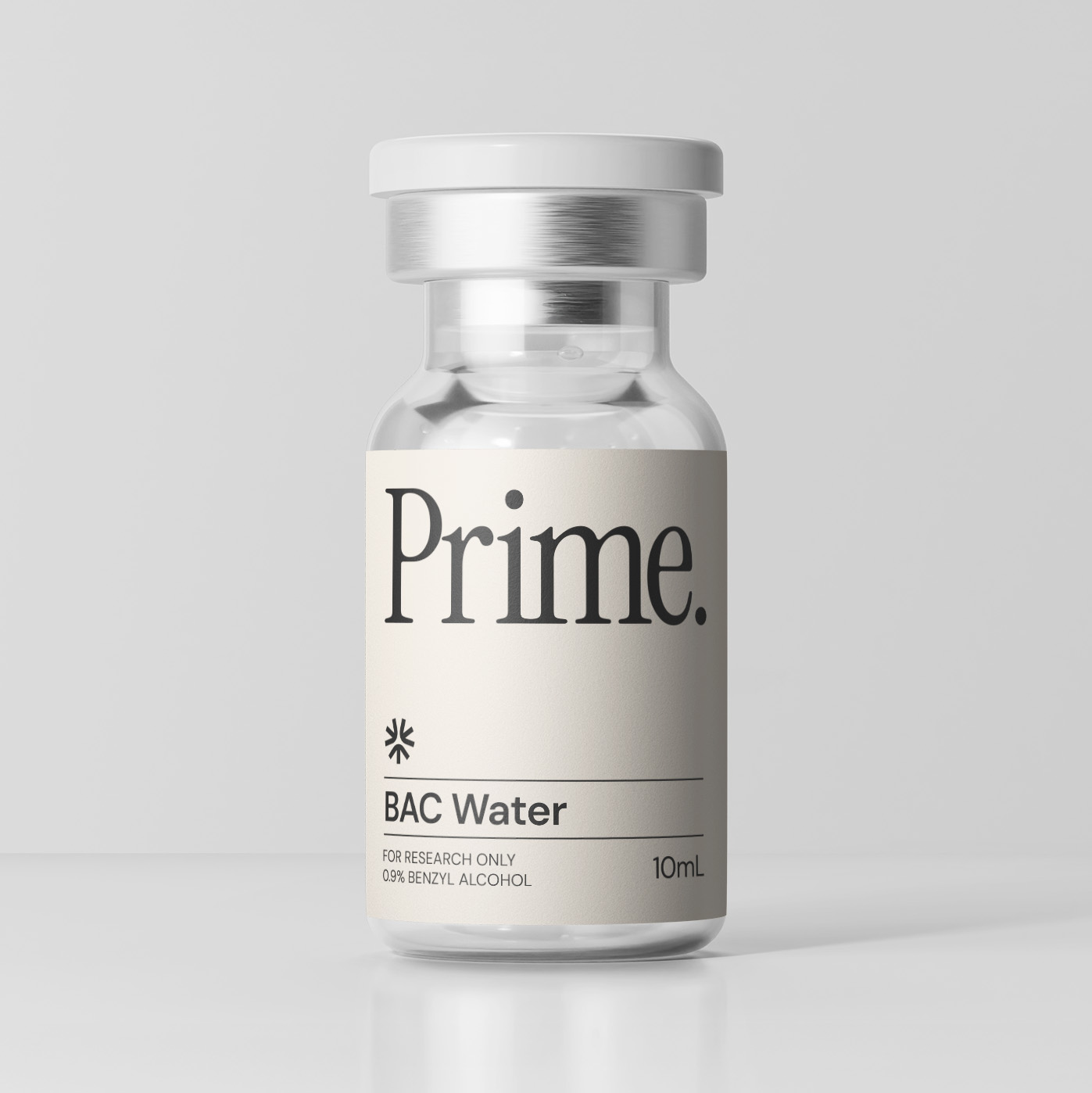
Bacteriostatic water carries 0.9% benzyl alcohol, which holds bacteria off for a few weeks in a vial that gets opened repeatedly. Sterile water has no preservative and is meant for single use. A 10 mL vial of BAC water covers about five 2 mL reconstitutions.
Skip the arithmetic. The Prime peptide calculator takes your vial size and water volume and gives you concentration and syringe volume instantly.
Open the calculator FAQ
Questions people ask with a syringe in hand.
How much bacteriostatic water do I add to a 5 mg vial?
Most researchers add 2 mL, which gives 2.5 mg/mL, so each 0.1 mL (10 units) holds 0.25 mg. Add 1 mL for a stronger 5 mg/mL solution, or 3 mL for a more dilute 1.7 mg/mL. All three are valid. The amount of peptide is the same.
How much bacteriostatic water do I add to a 10 mg vial?
2 mL is the usual choice, for 5 mg/mL and 0.5 mg in every 0.1 mL. If you want smaller amounts per draw, 3 mL gives 3.3 mg/mL. Going below 1 mL makes a very strong solution that is hard to measure accurately.
Is there a right amount of water?
No. The water sets the concentration, and any concentration that fits in the vial is valid. Between 1 and 5 mg/mL is the comfortable range because it keeps draws in the easy-to-read part of the syringe and leaves room in the vial to swirl.
Does more water make the peptide weaker?
It makes the solution more dilute, which is not the same thing. A 5 mg vial holds 5 mg whether you add 1 mL or 3 mL. More water just means each millilitre carries less of it, so you draw a larger volume to move the same amount.
Can I add more water after I’ve already mixed it?
Yes, if there is room in the vial. Swab the stopper, add fresh bacteriostatic water with a new sterile syringe, swirl gently, and recalculate the concentration using the total water now in the vial. You cannot remove water once it is in, so start low if you are unsure.
What if I added too much water?
The peptide is fine. Recalculate: total mg divided by total mL. You will draw larger volumes than planned, and if the vial is near its 3 mL capacity you have lost some room to swirl. That is the whole cost.
How long does the mixed vial last?
About four weeks in the fridge at 2 to 8 °C when mixed with bacteriostatic water, sometimes up to eight for more stable peptides. Sterile water has no preservative, so count in days. Our storage guide has the full chart.
Keep going
Useful next.
2.5 mg/mL
Tool
Peptide calculator
Vial size and water in, concentration and syringe volume out.
Shop
Bacteriostatic water, 10 mL
Enough for about five reconstitutions.
1
2
3
4
5
6
7
Guide
How to reconstitute peptides
The seven steps, with pictures.
❄
Guide
How long do peptides last?
Shelf life by storage method.
Research use only. All Prime Peptides products are for laboratory research purposes only. Not for human consumption, medical, or veterinary use. This guide describes concentration math for laboratory preparation and is not medical advice. The buyer is responsible for adhering to all local laws and regulations.