Your cart is empty.
Shop peptides
How to Reconstitute Peptides
Research guide · Lab basics
How to reconstitute peptides.
Turning a vial of freeze-dried powder into a clear, ready-to-use solution takes about five minutes. Here is the whole process in plain English: what to buy, how much water to add, the seven steps, and the mistakes everyone makes once.
Updated September 2026 · 5 min read · Prime Peptides lab team

The 30-second version
In a hurry? Here it is.
Reconstituting a peptide means adding sterile liquid to the freeze-dried powder so it dissolves. Bacteriostatic water is the standard choice for research vials because it lets you draw from the same vial for weeks.
That is the whole thing. Keep reading for the why, the math and the pictures.
1
Wash your hands and wipe down your work surface.
2
Flip the caps off both vials and swab the rubber tops with alcohol.
3
Draw 1 to 2 mL of bacteriostatic water into the syringe.
4
Press the plunger with a slow, steady push.
5
Swirl gently until the liquid is clear.
6
Write the concentration and today’s date on the label.
7
Store it in the fridge at 2–8 °C (36–46 °F).
Before you start
What you need.
Four things, and you probably own two of them already. Set them all out before you open anything.
Your peptide vial
Lyophilized (freeze-dried) powder. It may look like a tiny white puck, a dusting, or almost nothing at all. All normal.
Bacteriostatic water
Sterile water with 0.9% benzyl alcohol. The alcohol keeps bacteria from growing, so the vial stays usable for weeks.
A sterile syringe
A 1 mL or 3 mL syringe with a needle for mixing. One fresh syringe per vial. Never reuse.
Alcohol swabs
70% isopropyl wipes. Two per session: one for each vial top.
+
Optional: gloves
Nitrile gloves are a nice touch, not a requirement. Clean, dry hands do the job.
The why
Why do peptides come as a powder?
Peptides are short chains of amino acids, and in water those chains slowly fall apart. Dry, they can sit happily for months. So manufacturers freeze-dry them (the word for this is lyophilization) and ship them as a powder, sealed under a rubber stopper.
Reconstitution is simply the reverse: you add the liquid back. Add it with a little care and the peptide dissolves into a clear solution you can measure from for weeks. The care is mostly about keeping things sterile and knowing your concentration, which is what the rest of this guide is for.
The liquid you add matters too. Bacteriostatic water is the everyday choice because its small dose of benzyl alcohol stops bacteria from growing, so one vial can be drawn from repeatedly. Sterile water has no preservative and is meant for single use. A few peptides prefer other solvents, which is why the storage line on your label and the product page are always worth a glance.
Months
How long an unopened, refrigerated lyophilized vial typically stays stable. Freeze-drying is the whole point.
~4 weeks
The commonly cited window for a vial reconstituted with bacteriostatic water and kept refrigerated. Stability varies by peptide.
0.9%
Benzyl alcohol in bacteriostatic water. Enough to hold bacteria off, gentle enough for multi-use vials.
The question everyone asks
How much bacteriostatic water should you add?
There is no single right amount. What you are really choosing is the concentration, and concentration is just division: milligrams of peptide divided by millilitres of water.
A 5 mg vial with 1 mL of water gives you 5 mg/mL. Add 2 mL instead and you get 2.5 mg/mL. Same peptide, same vial. More water simply makes small amounts easier to measure.
For most 5 mg and 10 mg research vials, 1 to 2 mL is the comfortable range. Check your vial’s capacity before going past 2 mL. Most hold about 3 mL, and you want room to swirl.
mg of peptide
÷
mL of water
=
mg per mL
Peptide
Water
Result
Per 0.1 mL
5 mg
1 mL
5 mg/mL
0.5 mg
5 mg
2 mL
2.5 mg/mL
0.25 mg
10 mg
1 mL
10 mg/mL
1 mg
10 mg
2 mL
5 mg/mL
0.5 mg
10 mg
3 mL
3.3 mg/mL
0.33 mg
Reading a 1 mL syringe
0.1 mL
0.5 mL
1 mL
0
25
50
75
100 units
Insulin-style syringes are marked in units. On a standard U-100 syringe, 100 units = 1 mL, so 10 units is 0.1 mL. Units measure volume, nothing else.
The method
The 7 steps, one at a time.
Slow is smooth. Every step here is easy. The only skill involved is patience in step five.
Room temp first
Step 1 · Set the scene
Start clean.
Wash your hands, wipe down a flat surface and lay everything out within reach. Let the vials come to room temperature if they were in the fridge, so condensation does not form inside.
Pro tip
Take the vials out 15 minutes early. Cold glass plus warm room equals fog on the inside.
Swab both tops
Step 2 · Prep the vials
Pop the caps. Wipe the tops.
Flip the plastic caps off both the peptide vial and the bacteriostatic water. Underneath is a rubber stopper. Wipe each one with a fresh alcohol swab and give it ten seconds to air-dry.
Pro tip
Do not blow on the stopper to dry it faster. That undoes the wiping.
Vial upside down
1 to 2 mL
Step 3 · Measure
Draw the water.
Pull the plunger back to the volume you want, then push that air into the water vial. It sounds odd, but it equalises the pressure so the water flows out easily. Turn the vial upside down and draw your 1 to 2 mL. Tap out any big bubbles.
Pro tip
Not sure how much? Use the table above, or the peptide calculator. When in doubt, 2 mL.
Slow, steady push
Step 4 · Add the water
Slow, steady push.
Push the needle through the peptide vial’s stopper and press the plunger slowly. You may have read that the water must run down the glass wall and never touch the powder. It makes no difference to the peptide. Onto the powder or down the side, it dissolves the same. A slower push just means fewer bubbles to wait out.
Pro tip
Pull the needle out slowly too. A quick yank can spray a drop of solution you would rather keep.
Gentle swirl
Step 5 · The patient part
Give it a swirl.
Roll the vial gently between your fingers or tilt it in slow circles. Most peptides dissolve within a minute or two. Some take longer, and that is fine. Heard that shaking destroys peptides? The evidence does not back that up. A shake will not break the peptide, it just whips up foam that looks cloudy and makes it harder to see whether everything dissolved. Swirling is simply the tidier habit.
Pro tip
If a few flecks remain after a couple of minutes, set the vial in the fridge for ten minutes and swirl again. Time works better than force.
Clear means good
Step 6 · Quality check
Hold it up to the light.
A properly reconstituted peptide is clear and colourless, like water. No floating bits, no haze, no colour. If it looks cloudy or has particles after a rest in the fridge, something went wrong. See the storage section for what to do.
Pro tip
A few tiny bubbles clinging to the glass are just air. Give them a minute.
5 mg/mL
09/29
❄
Date it. Chill it.
Step 7 · Finish
Date it. Chill it.
Your vial already says what is in it. Add two things to the label: the concentration (for example “5 mg/mL”) and today’s date. Then straight into the fridge at 2–8 °C (36–46 °F), away from light and away from the door, where the temperature swings every time it opens.
Pro tip
Keep reconstituted vials upright in a small box or cup so the stopper stays dry and nothing knocks them over.
Learn from everyone else
Six mistakes people make exactly once.
None of these are dangerous. All of them waste a vial.
× Don’t
Toss a vial that is only foamy
Foam and micro-bubbles from a shake or a fast pour look cloudy for a few minutes. Let it settle. Toss it only if it stays hazy or has visible particles.
× Don’t
Use tap, distilled or bottled water
None of them are sterile. Bacteriostatic water for multi-use vials, sterile water for single use. Nothing else.
× Don’t
Use plain sterile water for a multi-use vial
No preservative means bacteria can grow between draws. Sterile water is for single use.
× Don’t
Leave it on the counter
Once liquid, the clock is running. Room temperature speeds up breakdown. Fridge, always.
× Don’t
Skip the date
Two identical vials, mixed a week apart, look exactly the same by Thursday. Concentration and date, every time.
✓ Do
Use a fresh syringe every time
One sterile syringe per vial, per session. It is the cheapest insurance in the whole process.
After mixing
How long do reconstituted peptides last?
Shorter than the powder, longer than you might fear. These are the commonly cited windows. Stability varies by peptide, so treat your product page and label as the final word. More detail in our peptide storage guide.
State
Where
Typical window
Notes
Lyophilized powder
Unopened, sealed
Fridge, 2–8 °C
Months
Keep dry and out of light. Freezer for long-term.
Reconstituted
Bacteriostatic water
Fridge, 2–8 °C
Up to ~4 weeks
Multi-use. Date the vial the day you mix it.
Reconstituted
Sterile water
Fridge, 2–8 °C
Days
No preservative. Single use is the intent.
Reconstituted
Any solvent
Freezer
Avoid
Freeze-thaw cycles damage dissolved peptides.
When to let it go
Signs a vial is done.
It has gone cloudy or hazy and a rest in the fridge did not clear it.
You can see floating particles or a layer on the bottom.
It has taken on any colour at all.
It has been more than about four weeks since you mixed it.
It sat at room temperature for a day or more.
You are not sure when you mixed it. (This is why we write the date on it.)
Quick answers
Questions we get every week.
Bacteriostatic water vs. sterile water: what is the difference?
Both are sterile. Bacteriostatic water also contains 0.9% benzyl alcohol, which stops bacteria from multiplying inside the vial. That is what makes it suitable for a vial you will draw from over several weeks. Sterile water has no preservative, so it is intended for a single use.
My peptide looks cloudy. Did I ruin it?
Not necessarily. Some peptides take a few minutes to fully dissolve. Put the vial in the fridge for ten to fifteen minutes and swirl gently again. If it clears, you are fine. If it stays hazy, has visible particles or has changed colour, it is best discarded. Cloudiness in the first few minutes is usually foam or powder that has not finished dissolving. Cloudiness that will not clear is a different thing: an aggregate, a contamination, or a vial past its window.
What if there are bubbles or foam on top?
A few small bubbles clinging to the glass are just air and will go away on their own. A layer of foam means the vial was shaken or the water went in quickly. It has not harmed the peptide. Let the vial sit in the fridge and check that it is clear once the foam settles.
Does shaking really ruin peptides?
Not in any way that has been demonstrated. The “never shake” rule was borrowed from large protein biologics, which can unfold and clump when agitated. Research peptides are short, simple chains. A 2026 stability study stirred and shook seven therapeutic peptides for days and measured no loss of peptide content by HPLC, although a few formed small aggregate particles under that prolonged agitation. A few seconds of hand-shaking is nowhere near that. What shaking does do is make foam, which looks alarming and gets in the way of an accurate draw. Swirl because it is neater, not because the peptide is fragile.
Is there a “right” amount of water?
No. The amount of water sets the concentration, and any concentration that fits in the vial is valid. Between 1 and 2 mL is typical for 5 mg and 10 mg vials because it keeps the math simple and leaves room in the vial. More water gives a more dilute solution that is easier to measure in small volumes. Our peptide calculator does the arithmetic for you.
Why do syringes say “units” instead of mL?
Insulin-style syringes are marked in units for historical reasons. On a standard U-100 syringe, 100 units equals 1 mL, so each unit is 0.01 mL. Units are a measure of volume only. They tell you nothing about how much peptide is in that volume; that depends on the concentration you chose when you added the water.
Can I freeze a reconstituted peptide?
It is generally not recommended. Freezing and thawing a dissolved peptide stresses the molecule and can cause it to aggregate or break down. Keep the lyophilized powder in the freezer if you need long-term storage, and only reconstitute what you will use within a few weeks.
Can I use the same syringe for the water and the peptide?
For the mixing step itself, yes: one fresh sterile syringe draws the water and delivers it into the peptide vial. After that, do not reuse it. Every later draw from the vial should be with a new sterile syringe to keep the contents clean.
Does the peptide vial need to be refrigerated before I reconstitute it?
Lyophilized vials are best stored cold, but let them come to room temperature for about fifteen minutes before you open them. Opening a cold vial in a warm room pulls moisture inside as condensation.
Handy things
Everything on this page, in your cart or in your browser.
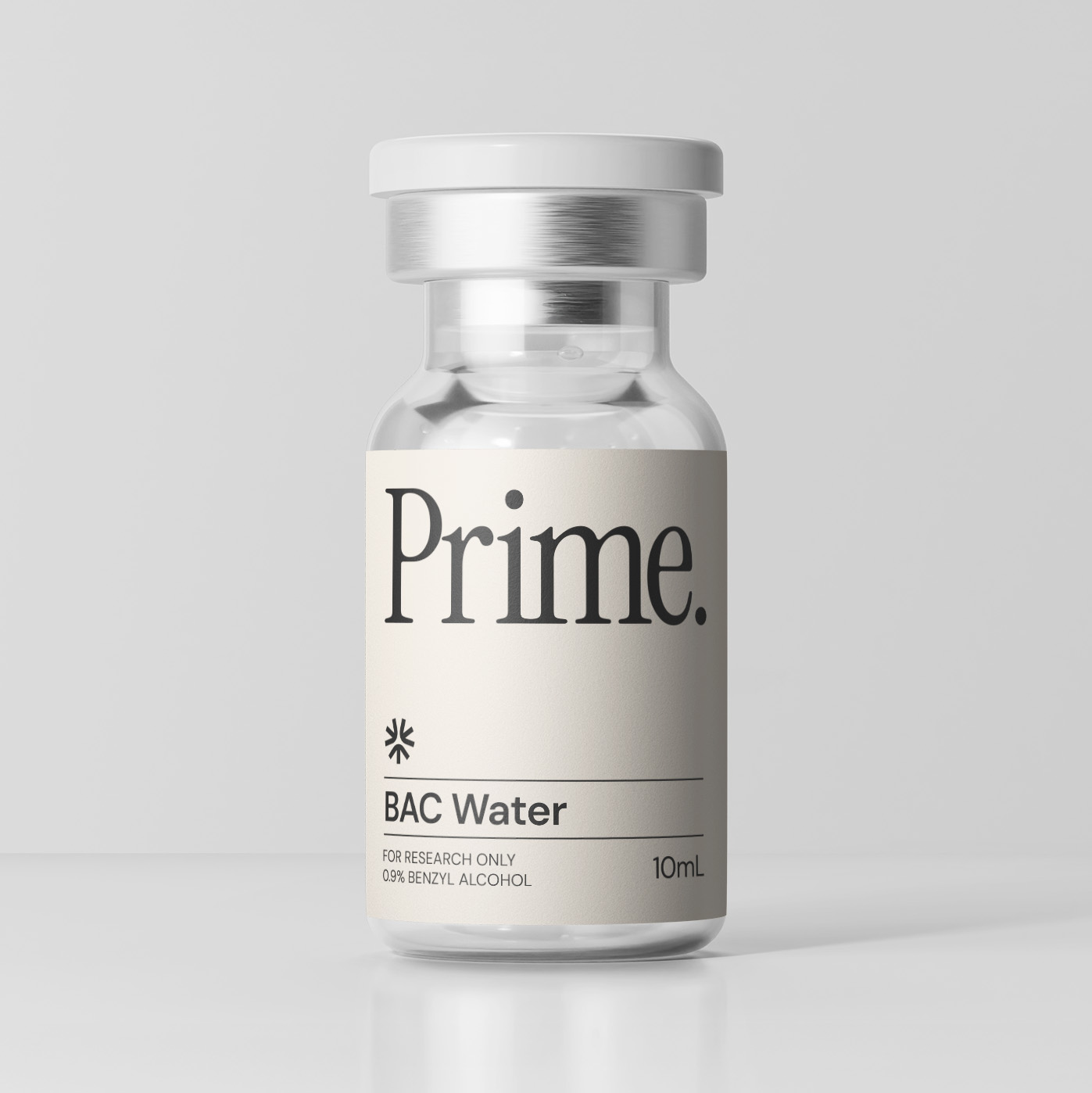
0.9% benzyl alcohol
Prime BAC Water, 10 mL
Sterile water with 0.9% benzyl alcohol. Enough for several vials. For research only.
Shop BAC Water →
mg/mL
2.5
Free tool
Peptide reconstitution calculator
Enter your vial size and water volume. Get the concentration and syringe volume instantly.
Open the calculator →
Research use only
All Prime Peptides products are for laboratory research purposes only. Not for human consumption, medical, or veterinary use. This guide describes general laboratory preparation of lyophilized peptides and is not medical advice. Always follow the storage and handling information on your product’s label and certificate of analysis.